Showing posts with label remnant. Show all posts
Showing posts with label remnant. Show all posts
Tuesday, 26 September 2017
Tychos Supernova Remnant
Tychos Supernova Remnant
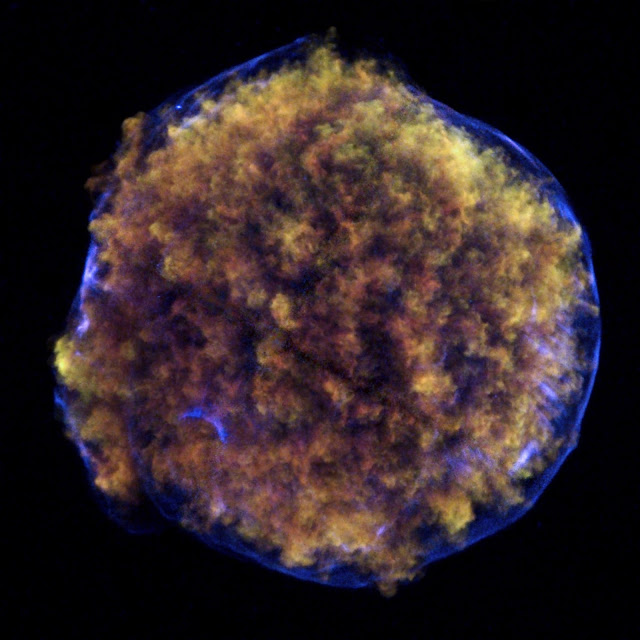
- An arc of emission just found in the Tycho supernova remnant provides evidence for what triggered the original explosion.
- Astronomers think that a shock wave created the arc when a white dwarf exploded and blew material off the surface of a nearby companion star.
- Tycho belongs to a category of supernovas that are used to measure the expansion of the Universe.
This new image of Tychos supernova remnant, dubbed Tycho for short, contains striking new evidence for what triggered the original supernova explosion, as seen from Earth in 1572. Tycho was formed by a Type Ia supernova, a category of stellar explosion used in measuring astronomical distances because of their reliable brightness.
Low and medium energy X-rays in red and green show expanding debris from the supernova explosion. High energy X-rays in blue reveal the blast wave, a shell of extremely energetic electrons. Also shown in the lower left region of Tycho is a blue arc of X-ray emission. Several lines of evidence support the conclusion that this arc is due to a shock wave created when a white dwarf exploded and blew material off the surface of a nearby companion star (see accompanying illustration below). Previously, studies with optical telescopes have revealed a star within the remnant that is moving much more quickly than its neighbors, hinting that it could be the companion to the supernova that was given a kick by the explosion.
Other details of the arc support the idea that it was blasted away from the companion star. For example, the X-ray emission of the remnant shows an apparent "shadow" next to the arc, consistent with the blocking of debris from the explosion by the expanding cone of material stripped from the companion. This shadow is most obvious in very high energy X-rays showing iron debris.
These pieces of evidence support a popular scenario for triggering a Type Ia supernova, where a white dwarf pulls material from a "normal," or Sun-like, companion star until a thermonuclear explosion occurs. In the other main competing theory, a merger of two white dwarfs occurs, and in this case, no companion star or evidence for material blasted off a companion, should exist. Both scenarios may actually occur under different conditions, but the latest Chandra result from Tycho supports the former one.
The shape of the arc is different from any other feature seen in the remnant. Other features in the interior of the remnant include recently announced stripes, which have a different shape and are thought to be features in the outer blast wave caused by cosmic ray acceleration.
Image Credit: NASA/CXC/Chinese Academy of Sciences/F. Lu et al
Explanation from: http://chandra.harvard.edu/photo/2011/tycho2/
download file now

Saturday, 2 September 2017
Supernova Remnant G299 2 2 9
Supernova Remnant G299 2 2 9

- G299.2-2.9 is a supernova remnant found about 16,000 light years from Earth in the Milky Way galaxy.
- It is the remains of a Type Ia supernova, the class of explosions astronomers use to measure the accelerating Universe and dark energy.
- High-mass stars are those that contain 8 times the Suns mass or more.
- Because it is older than most Type Ia remnants astronomers have found, G299.2-2.9 gives a look at how the remnants evolve over time.
G299.2-2.9 is an intriguing supernova remnant found about 16,000 light years away in the Milky Way galaxy . Evidence points to G299.2-2.9 being the remains of a Type Ia supernova, where a white dwarf has grown sufficiently massive to cause a thermonuclear explosion. Because it is older than most supernova remnants caused by these explosions, at an age of about 4500 years, G299.2-2.9 provides astronomers with an excellent opportunity to study how these objects evolve over time. It also provides a probe of the Type Ia supernova explosion that produced this structure.
This composite image shows G299.2-2.9 in X-ray light from Chandra, along with data from the ROSAT satellite (orange), that has been overlaid on an infrared image from the Two Micron All-Sky Survey (2MASS). The faint X-ray emission from the inner region reveals relatively large amounts of iron and silicon, as expected for a remnant of a Type Ia supernova. The outer shell of the remnant is complex, with at least a double shell structure. Typically, such a complex outer shell is associated with a star that has exploded into space where gas and dust are not uniformly distributed.
Since most theories to explain Type Ia supernovas assume they go off in a uniform environment, detailed studies of this complicated outer shell should help astronomers improve their understanding of the environments where these explosions occur. It is very important to understand the details of Type Ia explosions because astronomers use them as cosmic mile markers to measure the accelerated expansion of the universe and study dark energy. The discovery of this accelerated expansion in the late 1990s led to the recent award of the Nobel Prize in Physics.
Image Credit: X-ray: NASA/CXC/U. Texas at Arlington/S.Park et al, ROSAT; Infrared: 2MASS/UMass/IPAC-Caltech/NASA/NSF
Explanation from: http://chandra.harvard.edu/photo/2011/g299/
download file now
Subscribe to:
Posts (Atom)