Showing posts with label ngc. Show all posts
Showing posts with label ngc. Show all posts
Sunday, 24 September 2017
Spiral Galaxy NGC 2500
Spiral Galaxy NGC 2500

Discovered by British astronomer William Herschel over 200 years ago, NGC 2500 lies about 30 million light-years away in the northern constellation of Lynx. As this NASA/ESA Hubble Space Telescope image shows, NGC 2500 is a particular kind of spiral galaxy known as a barred spiral, its wispy arms swirling out from a bright, elongated core.
Barred spirals are actually more common than was once thought. Around two-thirds of all spiral galaxies � including the Milky Way � exhibit these straight bars cutting through their centres. These cosmic structures act as glowing nurseries for newborn stars, and funnel material towards the active core of a galaxy. NGC 2500 is still actively forming new stars, although this process appears to be occurring very unevenly. The upper half of the galaxy � where the spiral arms are slightly better defined � hosts many more star-forming regions than the lower half, as indicated by the bright, dotted islands of light.
There is another similarity between NGC 2500 and our home galaxy. Together with Andromeda, Triangulum, and many smaller natural satellites, the Milky Way is part of the Local Group of galaxies, a gathering of over 50 galaxies all loosely held together by gravity. NGC 2500 forms a similar group with some of its nearby neighbours, including NGC 2541, NGC 2552, NGC 2537, and the bright, Andromeda-like spiral NGC 2481 (known collectively as the NGC 2841 group).
Image Credit: ESA/Hubble & NASA
Explanation from: https://www.spacetelescope.org/images/potw1728a/
download file now

Friday, 22 September 2017
Dwarf Galaxy NGC 5949
Dwarf Galaxy NGC 5949

The subject of this NASA/ESA Hubble Space Telescope image is a dwarf galaxy named NGC 5949. Thanks to its proximity to Earth � it sits at a distance of around 44 million light-years from us, placing it within the Milky Way�s cosmic neighbourhood � NGC 5949 is a perfect target for astronomers to study dwarf galaxies.
With a mass of about a hundredth that of the Milky Way, NGC 5949 is a relatively bulky example of a dwarf galaxy. Its classification as a dwarf is due to its relatively small number of constituent stars, but the galaxy�s loosely-bound spiral arms also place it in the category of barred spirals. This structure is just visible in this image, which shows the galaxy as a bright yet ill-defined pinwheel. Despite its small proportions, NGC 5949�s proximity has meant that its light can be picked up by fairly small telescopes, something that facilitated its discovery by the astronomer William Herschel in 1801.
Astronomers have run into several cosmological quandaries when it comes to dwarf galaxies like NGC 5949. For example, the distribution of dark matter within dwarfs is quite puzzling (the �cuspy halo� problem), and our simulations of the Universe predict that there should be many more dwarf galaxies than we see around us (the �missing satellites� problem).
Image Credit: ESA/Hubble & NASA
Explanation from: https://www.spacetelescope.org/images/potw1732a/
download file now
Monday, 11 September 2017
Planetary Nebula NGC 6210
Planetary Nebula NGC 6210

The NASA/ESA Hubble Space Telescope has taken a striking high resolution image of the curious planetary nebula NGC 6210. Located about 6500 light-years away, in the constellation of Hercules, NGC 6210 was discovered in 1825 by the German astronomer Friedrich Georg Wilhelm Struve. Although in a small telescope it appears only as a tiny disc, it is fairly bright.
NGC 6210 is the last gasp of a star slightly less massive than our Sun at the final stage of its life cycle. The multiple shells of material ejected by the dying star form a superposition of structures with different degrees of symmetry, giving NGC 6210 its odd shape. This sharp image shows the inner region of this planetary nebula in unprecedented detail, where the central star is surrounded by a thin, bluish bubble that reveals a delicate filamentary structure. This bubble is superposed onto an asymmetric, reddish gas formation where holes, filaments and pillars are clearly visible.
The life of a star ends when the fuel available to its thermonuclear engine runs out. The estimated lifetime for a Sun-like star is some ten billion years. When the star is about to expire, it becomes unstable and ejects its outer layers, forming a planetary nebula and leaving behind a tiny, but very hot, remnant, known as white dwarf. This compact object, here visible at the centre of the image, cools down and fades very slowly. Stellar evolution theory predicts that our Sun will experience the same fate as NGC 6210 in about five billion years.
This picture was created from images taken with Hubble�s Wide Field Planetary Camera 2 through three filters: the broadband filter F555W (yellow) and the narrowband filters F656N (ionised hydrogen), F658N (ionised nitrogen) and F502N (ionised oxygen). The exposure times were 80 s, 140 s, 800 s and 700 s respectively and the field of view is only about 28 arcseconds across.
Image Credit: ESA/Hubble and NASA
Explanation from: https://www.spacetelescope.org/images/potw1026a/
download file now
Saturday, 9 September 2017
Spiral Galaxy NGC 4242
Spiral Galaxy NGC 4242

Tucked away in the small northern constellation of Canes Venatici (The Hunting Dogs) is the galaxy NGC 4242, shown here as seen by the NASA/ESA Hubble Space Telescope. The galaxy lies some 30 million light-years from us. At this distance from Earth, actually not all that far on a cosmic scale, NGC 4242 is visible to anyone armed with even a basic telescope (as British astronomer William Herschel found when he discovered the galaxy in 1788).
This image shows the galaxy�s bright centre and the surrounding dimmer and more diffuse �fuzz�. Despite appearing to be relatively bright in this image, studies have found that NGC 4242 is actually relatively dim (it has a moderate-to-low surface brightness and low luminosity) and also supports a low rate of star formation. The galaxy also seems to have a weak bar of stars cutting through its asymmetric centre, and a very faint and poorly-defined spiral structure throughout its disc. But if NGC 4242 is not all that remarkable, as with much of the Universe, it is still a beautiful and ethereal sight.
Image Credit: ESA/Hubble & NASA
Explanation from: https://www.spacetelescope.org/images/potw1729a/
download file now
Thursday, 31 August 2017
Spiral Galaxy NGC 3628
Spiral Galaxy NGC 3628
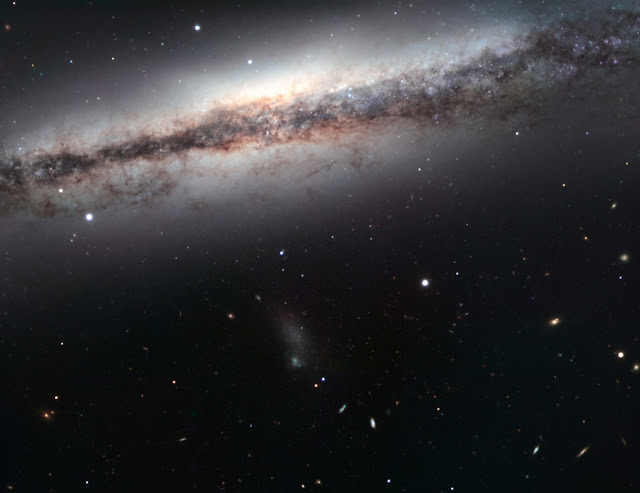
NGC 3628 is a spiral galaxy and a member of a small, but conspicuous group of galaxies located about 35 million light-years away, toward the constellation of Leo (the Lion). The other distinguished members of this family, known collectively as the Leo Triplet, are two well-known prominent spiral galaxies, Messier 65 and Messier 66 (not seen on the image), which were both discovered in 1780 by famous French comet hunter Charles Messier. NGC 3628 is the faintest of the trio and escaped Messier�s observations with his rather small telescope. It was discovered and catalogued by William Herschel only four years later.
NGC 3628 hides its spiral structure because it is seen perfectly edge-on, exactly as we observe the Milky Way on a clear night. Its most distinctive feature is a dark band of dust that lies across the plane of the disc and which is visibly distorted outwards, as a consequence of the gravitational interaction between NGC 3628 and its bullying companions. This boxy or �peanut-shaped� bulge, seen as a faint X-shape, is formed mainly of young stars and gas and dust, which create the bulge away from the plane of the rest of the galaxy through their powerful motions. Because of its appearance, NGC 3628 was catalogued as Arp 317 in the Atlas of Peculiar Galaxies, published in 1966, which aimed to characterise a large sample of odd objects that fell outside the standard Hubble classification, to aid understanding of how galaxies evolve.
The depth of the image reveals a myriad of galaxies of different shapes and colours, some of which lie much further away than NGC 3628. Particularly noticeable is the fuzzy blob just in the centre of the image, which is a diffuse satellite galaxy. A number of globular clusters can be seen as fuzzy reddish spots in the halo of the galaxy. Also visible as bright spots near the lower edge of the image (the two blue star-like objects below the satellite galaxy) are two quasars, the central engines of distant and very energetic galaxies, billions of light-years away.
This image has been taken with the FORS2 instrument, attached to one of the ESO Very Large Telescope�s Unit Telescopes. It is a combination of exposures taken through different filters (B, V and R), for a total exposure time of just below one hour. The field of view is about 7 arcminutes across, which is why this large galaxy does not fit into the image.
Image Credit: ESO
Explanation from: https://www.eso.org/public/images/potw1026a/
download file now
Saturday, 26 August 2017
Dwarf Galaxy NGC 178
Dwarf Galaxy NGC 178

NGC 178 may be small, but it packs quite a punch. Measuring around 40 000 light-years across, its diameter is less than half that of the Milky Way, and it is accordingly classified as a dwarf galaxy. Despite its diminutive size, NGC 178 is busy forming new stars. On average, the galaxy forms stars totalling around half the mass of the Sun per year � enough to label it a starburst galaxy.
The galaxy�s discovery is an interesting, and somewhat confusing, story. It was originally discovered by American astronomer Ormond Stone in 1885 and dubbed NGC 178, but its position in the sky was recorded incorrectly � by accident the value for the galaxy�s right ascension (which can be thought of as the celestial equivalent of terrestrial longitude) was off by a considerable amount.
In the years that followed NGC 178 was spotted again, this time by French astronomer St�phane Javelle. As no catalogued object occupied that position in the sky, Javelle believed he had discovered a new galaxy and entered it into the expanded Index Catalogue under the name IC 39. Later, American astronomer Herbert Howe also observed the object and corrected Stone�s initial mistake. Many years later, astronomers finally noticed that NGC 178 and IC 39 were actually the same object!
This image of NGC 178 comprises data gathered by the Wide Field Planetary Camera 2 aboard the NASA/ESA Hubble Space Telescope.
Image Credit: ESA/Hubble & NASA
Explanation from: https://www.spacetelescope.org/images/potw1734a/
download file now
Friday, 25 August 2017
Globular Cluster NGC 6535
Globular Cluster NGC 6535

This image captures the stunning NGC 6535, a globular cluster 22 000 light-years away in the constellation of Serpens (The Serpent) that measures one light-year across.
Globular clusters are tightly bound groups of stars which orbit galaxies. The large mass in the rich stellar centre of the globular cluster pulls the stars inward to form a ball of stars. The word globulus, from which these clusters take their name, is Latin for small sphere.
Globular clusters are generally very ancient objects formed around the same time as their host galaxy. To date, no new star formations have been observed within a globular cluster, which explains the abundance of aging yellow stars in this image, most of them containing very few heavy elements.
NGC 6535 was first discovered in 1852 by English astronomer John Russell Hind. The cluster would have appeared to Hind as a small, faint smudge through his telescope. Now, over 160 years later, instruments like the Advanced Camera for Surveys (ACS) and Wide Field Camera 3 (WFC3) on the NASA/ESA Hubble Space Telescope allow us to capture the cluster close up and marvel at its contents in detail.
Image Credit: ESA/Hubble & NASA, Gilles Chapdelaine
Explanation from: https://www.spacetelescope.org/images/potw1452a/
download file now
Thursday, 24 August 2017
Globular Cluster NGC 6752
Globular Cluster NGC 6752

Looking like a hoard of gems fit for an emperor�s collection, this deep sky object called NGC 6752 is in fact far more worthy of admiration. It is a globular cluster, and at over 10 billion years old is one the most ancient collections of stars known. It has been blazing for well over twice as long long as our Solar System has existed.
NGC 6752 contains a high number of �blue straggler� stars, some of which are visible in this image. These stars display characteristics of stars younger than their neighbours, despite models suggesting that most of the stars within globular clusters should have formed at approximately the same time. Their origin is therefore something of a mystery.
Studies of NGC 6752 may shed light on this situation. It appears that a very high number � up to 38% � of the stars within its core region are binary systems. Collisions between stars in this turbulent area could produce the blue stragglers that are so prevalent.
Lying 13 000 light-years distant, NGC 6752 is far beyond our reach, yet the clarity of Hubble�s images brings it tantalisingly close.
Image Credit: ESA/Hubble & NASA
Explanation from: https://www.spacetelescope.org/images/potw1205a/
download file now
Sunday, 20 August 2017
Spiral Galaxy NGC 7098
Spiral Galaxy NGC 7098

Approximately 95 million light-years away, in the southern constellation of Octans (The Octant), lies NGC 7098 � an intriguing spiral galaxy with numerous sets of double features. The first of NGC 7098�s double features is a duo of distinct ring-like structures that loop around the galaxy�s hazy heart. These are NGC 7098�s spiral arms, which have wound themselves around the galaxy�s luminous core. This central region hosts a second double feature: a double bar.
NGC 7098 has also developed features known as ansae, visible as small, bright streaks at each end of the central region. Ansae are visible areas of overdensity � they commonly take looping, linear, or circular shapes, and can be found at the extremities of planetary ring systems, in nebulous clouds, and, as is the case with NGC 7098, in parts of galaxies that are packed to the brim with stars.
This image is formed from data gathered by the FOcal Reducer and low dispersion Spectrograph (FORS) instrument, installed on ESO�s Very Large Telescope at Paranal Observatory. An array of distant galaxies are also visible throughout the frame, the most prominent being the small, edge-on, spiral galaxy visible to the left of NGC 7098, known as ESO 048-G007.
Image Credit: ESO
Explanation from: https://www.eso.org/public/images/potw1730a/
download file now
Saturday, 19 August 2017
Lenticular Galaxy NGC 4886
Lenticular Galaxy NGC 4886

The constellation of Virgo (The Virgin) is the largest of the Zodiac constellations, and the second largest overall after Hydra (The Water Snake). Its most appealing feature, however, is the sheer number of galaxies that lie within it. In this picture, among a crowd of face- and edge-on spiral, elliptical, and irregular galaxies, lies NGC 4866, a lenticular galaxy situated about 80 million light-years from Earth.
Lenticular galaxies are somewhere between spirals and ellipticals in terms of shape and properties. From the picture, we can appreciate the bright central bulge of NGC 4886, which contains primarily old stars, but no spiral arms are visible. The galaxy is seen from Earth as almost edge-on, meaning that the disc structure � a feature not present in elliptical galaxies � is clearly visible. Faint dust lanes trace across NGC 4866 in this image, obscuring part of the galaxy�s light.
To the right of the galaxy is a very bright star that appears to lie within NGC 4886�s halo. However, this star actually lies much closer to us; in front of the galaxy, along our line of sight. These kinds of perspective tricks are common when observing, and can initially deceive astronomers as to the true nature and position of objects such as galaxies, stars, and clusters.
This sharp image of NGC 4866 was captured by the Advanced Camera for Surveys, an instrument on the NASA/ESA Hubble Space Telescope.
Image Credit: ESA/Hubble & NASA, Gilles Chapdelaine
Explanation from: https://www.spacetelescope.org/images/potw1328a/
download file now
Wednesday, 16 August 2017
Elliptical Galaxy NGC 2768
Elliptical Galaxy NGC 2768

Like a lighthouse in the fog the luminous core of NGC 2768 slowly fades outwards to a dull white haze in this image taken by the NASA/ESA Hubble Space Telescope.
NGC 2768 is an elliptical galaxy in the constellation of Ursa Major (The Great Bear). It is a huge bundle of stars, dominated by a bright central region, where a supermassive black hole feasts on a constant stream of gas and dust being fed to it by its galactic host.
The galaxy is also marked by a prominent plume of dust reaching out from the centre and lying perpendicular to the galaxy�s plane. This dust conceals a symmetrical, s-shaped pair of jets that are being produced by the supermassive black hole as it feeds.
Image Credit: ESA/Hubble, NASA and S. Smartt (Queens University Belfast)
Explanation from: https://www.spacetelescope.org/images/potw1548a/
download file now
Spiral Galaxy NGC 4656
Spiral Galaxy NGC 4656

This galaxy known as NGC 4656 is located in the constellation of Canes Venatici (The Hunting Dogs). However, it also has a somewhat more interesting and intriguing name: the Hockey Stick Galaxy! The reason for this is a little unclear from this partial view, which shows the bright central region, but the galaxy is actually shaped like an elongated, warped stick, stretching out through space until it curls around at one end to form a striking imitation of a celestial hockey stick.
This unusual shape is thought to be due to an interaction between NGC 4656 and a couple of near neighbours, NGC 4631 (otherwise known as The Whale Galaxy) and NGC 4627 (a small elliptical). Galactic interactions can completely reshape a celestial object, shifting and warping its constituent gas, stars, and dust into bizarre and beautiful configurations. The NASA/ESA Hubble Space Telescope has spied a large number of interacting galaxies over the years, from the cosmic rose of Arp 273 to the egg-penguin duo of Arp 142 and the pinwheel swirls of Arp 240.
Image Credit: ESA/Hubble & NASA
Explanation from: https://www.spacetelescope.org/images/potw1731a/
download file now
Tuesday, 8 August 2017
Planetary Nebula NGC 6563
Planetary Nebula NGC 6563

The planetary nebula NGC 6563 resides in a crowded starry region of the sky. In natural sky conditions many of these stars remain invisible due to the blurring effect of the Earth�s atmosphere. When the AOF supplies its superb correction a myriad fainter stars become visible, together with a sharper view of the dusty parts of the nebula itself.
Image Credit: ESO/P. Weilbacher
Explanation from: https://www.eso.org/public/images/eso1724cb/
download file now
Saturday, 5 August 2017
Spiral Galaxy NGC 4248
Spiral Galaxy NGC 4248

This beautiful clump of glowing gas, dark dust, and glittering stars is the spiral galaxy NGC 4248, located about 24 million light-years away in the constellation of Canes Venatici (The Hunting Dogs).
This image was produced by the NASA/ESA Hubble Space Telescope as it embarked upon compiling the first Hubble ultraviolet �atlas�, for which the telescope targeted 50 nearby star-forming galaxies. A sample spanning all kinds of different morphologies, masses, and structures. Studying this sample can help us to piece together the star-formation history of the Universe.
By exploring how massive stars form and evolve within such galaxies, astronomers can learn more about how, when, and where star formation occurs, how star clusters change over time, and how the process of forming new stars is related to the properties of both the host galaxy and the surrounding interstellar medium (the �stuff� that fills the space between individual stars).
This image is formed of observations from Hubble�s Wide Field Camera 3.
Image Credit: ESA/Hubble & NASA
Explanation from: https://www.spacetelescope.org/images/potw1730a/
download file now
Thursday, 3 August 2017
Planetary Nebula NGC 6369
Planetary Nebula NGC 6369

Known as the Little Ghost Nebula, NGC 6369 is a planetary nebula in the constellation Ophiuchus, the serpent-bearer. The nebula is relatively faint with an apparent magnitude of 12.9 and the clear detail of this image shows the power of the AOF-equipped MUSE instrument of the VLT. The white dwarf star is clearly visible in the middle of the nebular gas, which is expanding out in rings.
Image Credit: ESO/P. Weilbacher (AIP)
Explanation from: https://www.eso.org/public/images/eso1724h/
download file now
Subscribe to:
Posts (Atom)