Showing posts with label spiral. Show all posts
Showing posts with label spiral. Show all posts
Sunday, 24 September 2017
Spiral Galaxy NGC 2500
Spiral Galaxy NGC 2500

Discovered by British astronomer William Herschel over 200 years ago, NGC 2500 lies about 30 million light-years away in the northern constellation of Lynx. As this NASA/ESA Hubble Space Telescope image shows, NGC 2500 is a particular kind of spiral galaxy known as a barred spiral, its wispy arms swirling out from a bright, elongated core.
Barred spirals are actually more common than was once thought. Around two-thirds of all spiral galaxies � including the Milky Way � exhibit these straight bars cutting through their centres. These cosmic structures act as glowing nurseries for newborn stars, and funnel material towards the active core of a galaxy. NGC 2500 is still actively forming new stars, although this process appears to be occurring very unevenly. The upper half of the galaxy � where the spiral arms are slightly better defined � hosts many more star-forming regions than the lower half, as indicated by the bright, dotted islands of light.
There is another similarity between NGC 2500 and our home galaxy. Together with Andromeda, Triangulum, and many smaller natural satellites, the Milky Way is part of the Local Group of galaxies, a gathering of over 50 galaxies all loosely held together by gravity. NGC 2500 forms a similar group with some of its nearby neighbours, including NGC 2541, NGC 2552, NGC 2537, and the bright, Andromeda-like spiral NGC 2481 (known collectively as the NGC 2841 group).
Image Credit: ESA/Hubble & NASA
Explanation from: https://www.spacetelescope.org/images/potw1728a/
download file now

Saturday, 23 September 2017
Spiral Galaxy Messier 77
Spiral Galaxy Messier 77

ESO�s Very Large Telescope (VLT) has captured a magnificent face-on view of the barred spiral galaxy Messier 77. The image does justice to the galaxy�s beauty, showcasing its glittering arms criss-crossed with dust lanes � but it fails to betray Messier 77�s turbulent nature.
This picturesque spiral galaxy appears to be tranquil, but there is more to it than meets the eye. Messier 77 (also known as NGC 1068) is one of the closest active galaxies, which are some of the most energetic and spectacular objects in the Universe. Their nuclei are often bright enough to outshine the whole of the rest of the galaxy. Active galaxies are among the brightest objects in the Universe and emit light at most, if not all, wavelengths, from gamma rays and X-rays all the way to microwaves and radiowaves. Messier 77 is further classified as a Type II Seyfert galaxy, characterised by being particularly bright at infrared wavelengths.
This impressive luminosity is caused by intense radiation blasting out from a central engine � the accretion disc surrounding a supermassive black hole. Material that falls towards the black hole is compressed and heated up to incredible temperatures, causing it to radiate a tremendous amount of energy. This accretion disc is thought to be enshrouded by thick doughnut-shaped structure of gas and dust, called a �torus�. Observations of Messier 77 back in 2003 were the first to resolve such a structure using the powerful VLT Interferometer.
This image of Messier 77 was taken in four different wavelength bands represented by blue, red, violet and pink (hydrogen-alpha) colours. Each wavelength brings out a different quality: for example, the pinkish hydrogen-alpha highlights the hotter and younger stars forming in the spiral arms, while in red are the fine, thread-like filamentary structures in the gas surrounding Messier 77. A foreground Milky Way star is also seen beside the galaxy centre, displaying tell-tale diffraction spikes. Additionally, many more distant galaxies are visible; sitting at the outskirts of the spiral arms, they appear tiny and delicate compared to the colossal active galaxy .
Located 47 million light-years away in the constellation of Cetus (The Sea Monster), Messier 77 is one of the most remote galaxies of the Messier catalogue. Initially, Messier believed that the highly luminous object he saw through his telescope was a cluster of stars, but as technology progressed its true status as a galaxy was realised. At approximately 100 000 light-years across, Messier 77 is also one of largest galaxies in the Messier catalogue � so massive that its gravity causes other nearby galaxies to twist and become warped.
This image was obtained using the FOcal Reducer and low dispersion Spectrograph 2 (FORS2) instrument mounted on Unit Telescope 1 (Antu) of the VLT, located at ESO�s Paranal Observatory in Chile. It hails from ESO�s Cosmic Gems programme, an outreach initiative that produces images of interesting, intriguing or visually attractive objects using ESO telescopes for the purposes of education and outreach.
Image Credit: ESO
Explanation from: https://www.eso.org/public/news/eso1720/
download file now
Sunday, 17 September 2017
Spiral Galaxy IC 342
Spiral Galaxy IC 342

IC 342 is a challenging cosmic target. Although it is bright, the galaxy sits near the equator of the Milky Way�s galactic disc, where the sky is thick with glowing cosmic gas, bright stars, and dark, obscuring dust. In order for astronomers to see the intricate spiral structure of IC 342, they must gaze through a large amount of material contained within our own galaxy � no mean feat! As a result IC 342 is relatively difficult to spot and image, giving rise to its intriguing nickname: the �Hidden Galaxy�.
Located very close (in astronomical terms!) to the Milky Way, this sweeping spiral galaxy would be among the brightest in the sky were it not for its dust-obscured location. The galaxy is very active, as indicated by the range of colours visible in this NASA/ESA Hubble Space Telescope image, depicting the very central region of the galaxy. A beautiful mixture of hot, blue star-forming regions, redder, cooler regions of gas, and dark lanes of opaque dust can be seen, all swirling together around a bright core. In 2003, astronomers confirmed this core to be a specific type of central region known as an HII nucleus � a name that indicates the presence of ionised hydrogen � that is likely to be creating many hot new stars.
Image Credit: ESA/Hubble & NASA
Explanation from: https://www.spacetelescope.org/images/potw1727a/
download file now
Saturday, 9 September 2017
Spiral Galaxy NGC 4242
Spiral Galaxy NGC 4242

Tucked away in the small northern constellation of Canes Venatici (The Hunting Dogs) is the galaxy NGC 4242, shown here as seen by the NASA/ESA Hubble Space Telescope. The galaxy lies some 30 million light-years from us. At this distance from Earth, actually not all that far on a cosmic scale, NGC 4242 is visible to anyone armed with even a basic telescope (as British astronomer William Herschel found when he discovered the galaxy in 1788).
This image shows the galaxy�s bright centre and the surrounding dimmer and more diffuse �fuzz�. Despite appearing to be relatively bright in this image, studies have found that NGC 4242 is actually relatively dim (it has a moderate-to-low surface brightness and low luminosity) and also supports a low rate of star formation. The galaxy also seems to have a weak bar of stars cutting through its asymmetric centre, and a very faint and poorly-defined spiral structure throughout its disc. But if NGC 4242 is not all that remarkable, as with much of the Universe, it is still a beautiful and ethereal sight.
Image Credit: ESA/Hubble & NASA
Explanation from: https://www.spacetelescope.org/images/potw1729a/
download file now
Thursday, 31 August 2017
Spiral Galaxy NGC 3628
Spiral Galaxy NGC 3628
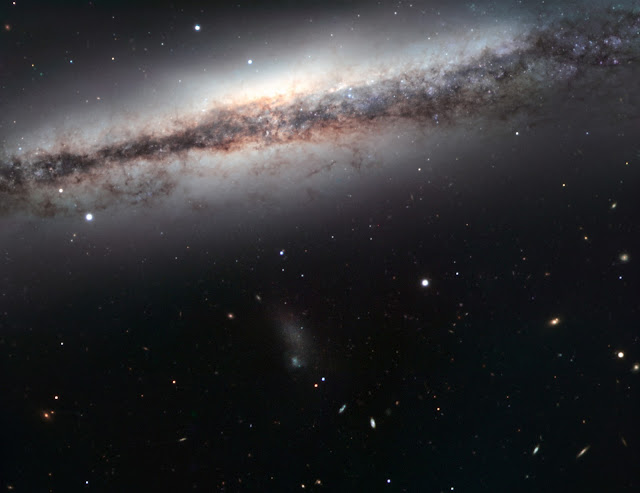
NGC 3628 is a spiral galaxy and a member of a small, but conspicuous group of galaxies located about 35 million light-years away, toward the constellation of Leo (the Lion). The other distinguished members of this family, known collectively as the Leo Triplet, are two well-known prominent spiral galaxies, Messier 65 and Messier 66 (not seen on the image), which were both discovered in 1780 by famous French comet hunter Charles Messier. NGC 3628 is the faintest of the trio and escaped Messier�s observations with his rather small telescope. It was discovered and catalogued by William Herschel only four years later.
NGC 3628 hides its spiral structure because it is seen perfectly edge-on, exactly as we observe the Milky Way on a clear night. Its most distinctive feature is a dark band of dust that lies across the plane of the disc and which is visibly distorted outwards, as a consequence of the gravitational interaction between NGC 3628 and its bullying companions. This boxy or �peanut-shaped� bulge, seen as a faint X-shape, is formed mainly of young stars and gas and dust, which create the bulge away from the plane of the rest of the galaxy through their powerful motions. Because of its appearance, NGC 3628 was catalogued as Arp 317 in the Atlas of Peculiar Galaxies, published in 1966, which aimed to characterise a large sample of odd objects that fell outside the standard Hubble classification, to aid understanding of how galaxies evolve.
The depth of the image reveals a myriad of galaxies of different shapes and colours, some of which lie much further away than NGC 3628. Particularly noticeable is the fuzzy blob just in the centre of the image, which is a diffuse satellite galaxy. A number of globular clusters can be seen as fuzzy reddish spots in the halo of the galaxy. Also visible as bright spots near the lower edge of the image (the two blue star-like objects below the satellite galaxy) are two quasars, the central engines of distant and very energetic galaxies, billions of light-years away.
This image has been taken with the FORS2 instrument, attached to one of the ESO Very Large Telescope�s Unit Telescopes. It is a combination of exposures taken through different filters (B, V and R), for a total exposure time of just below one hour. The field of view is about 7 arcminutes across, which is why this large galaxy does not fit into the image.
Image Credit: ESO
Explanation from: https://www.eso.org/public/images/potw1026a/
download file now
Sunday, 20 August 2017
Spiral Galaxy NGC 7098
Spiral Galaxy NGC 7098

Approximately 95 million light-years away, in the southern constellation of Octans (The Octant), lies NGC 7098 � an intriguing spiral galaxy with numerous sets of double features. The first of NGC 7098�s double features is a duo of distinct ring-like structures that loop around the galaxy�s hazy heart. These are NGC 7098�s spiral arms, which have wound themselves around the galaxy�s luminous core. This central region hosts a second double feature: a double bar.
NGC 7098 has also developed features known as ansae, visible as small, bright streaks at each end of the central region. Ansae are visible areas of overdensity � they commonly take looping, linear, or circular shapes, and can be found at the extremities of planetary ring systems, in nebulous clouds, and, as is the case with NGC 7098, in parts of galaxies that are packed to the brim with stars.
This image is formed from data gathered by the FOcal Reducer and low dispersion Spectrograph (FORS) instrument, installed on ESO�s Very Large Telescope at Paranal Observatory. An array of distant galaxies are also visible throughout the frame, the most prominent being the small, edge-on, spiral galaxy visible to the left of NGC 7098, known as ESO 048-G007.
Image Credit: ESO
Explanation from: https://www.eso.org/public/images/potw1730a/
download file now
Wednesday, 16 August 2017
Spiral Galaxy Messier 81
Spiral Galaxy Messier 81

This beautiful galaxy is tilted at an oblique angle on to our line of sight, giving a "birds-eye view" of the spiral structure. The galaxy is similar to our Milky Way, but our favorable view provides a better picture of the typical architecture of spiral galaxies.
M81 may be undergoing a surge of star formation along the spiral arms due to a close encounter it may have had with its nearby spiral galaxy NGC 3077 and a nearby starburst galaxy (M82) about 300 million years ago.
M81 is one of the brightest galaxies that can be seen from the Earth. It is high in the northern sky in the circumpolar constellation Ursa Major, the Great Bear. At an apparent magnitude of 6.8 it is just at the limit of naked-eye visibility. The galaxys angular size is about the same as that of the Full Moon.
This image combines data from the Hubble Space Telescope, the Spitzer Space Telescope, and the Galaxy Evolution Explorer (GALEX) missions. The GALEX ultraviolet data were from the far-UV portion of the spectrum (135 to 175 nanometers). The Spitzer infrared data were taken with the IRAC channel 4 detector (8 microns). The Hubble data were taken at the blue portion of the spectrum.
Image Credit: Hubble data: NASA, ESA
Explanation from: http://www.spitzer.caltech.edu/images/2126-sig07-009-Multiwavelength-M81
download file now
Spiral Galaxy NGC 4656
Spiral Galaxy NGC 4656

This galaxy known as NGC 4656 is located in the constellation of Canes Venatici (The Hunting Dogs). However, it also has a somewhat more interesting and intriguing name: the Hockey Stick Galaxy! The reason for this is a little unclear from this partial view, which shows the bright central region, but the galaxy is actually shaped like an elongated, warped stick, stretching out through space until it curls around at one end to form a striking imitation of a celestial hockey stick.
This unusual shape is thought to be due to an interaction between NGC 4656 and a couple of near neighbours, NGC 4631 (otherwise known as The Whale Galaxy) and NGC 4627 (a small elliptical). Galactic interactions can completely reshape a celestial object, shifting and warping its constituent gas, stars, and dust into bizarre and beautiful configurations. The NASA/ESA Hubble Space Telescope has spied a large number of interacting galaxies over the years, from the cosmic rose of Arp 273 to the egg-penguin duo of Arp 142 and the pinwheel swirls of Arp 240.
Image Credit: ESA/Hubble & NASA
Explanation from: https://www.spacetelescope.org/images/potw1731a/
download file now
Tuesday, 15 August 2017
Spiral Galaxy Messier 106
Spiral Galaxy Messier 106

Using a quartet of space observatories, University of Maryland astronomers may have cracked a 45-year mystery surrounding two ghostly spiral arms in the galaxy M106.
The Maryland team, led by Yuxuan Yang, took advantage of the unique capabilities of NASAs Chandra X-ray Observatory, NASAs Spitzer Space Telescope, the European Space Agencys XMM-Newton X-ray observatory, and data obtained almost a decade ago with NASAs Hubble Space Telescope.
M106 (also known as NGC 4258) is a stately spiral galaxy 23.5 million light-years away in the constellation Canes Venatici. In visible-light images, two prominent arms emanate from the bright nucleus and spiral outward. These arms are dominated by young, bright stars, which light up the gas within the arms. "But in radio and X-ray images, two additional spiral arms dominate the picture, appearing as ghostly apparitions between the main arms," says team member Andrew Wilson of the University of Maryland. These so-called "anomalous arms" consist mostly of gas.
"The nature of these anomalous arms is a long-standing puzzle in astronomy," says Yang. "They have been a mystery since they were first discovered in the early 1960s."
By analyzing data from XMM-Newton, Spitzer, and Chandra, Yang, Bo Li, Wilson, and Christopher Reynolds, all at the University of Maryland at College Park, have confirmed earlier suspicions that the ghostly arms represent regions of gas that are being violently heated by shock waves.
Previously, some astronomers had suggested that the anomalous arms are jets of particles being ejected by a supermassive black hole in M106s nucleus. But radio observations by the National Radio Astronomy Observatorys Very Long Baseline Array, and the Very Large Array in New Mexico, later identified another pair of jets originating in the core. "It is highly unlikely that an active galactic nucleus could have more than one pair of jets," says Yang.
In 2001, Wilson, Yang, and Gerald Cecil, of the University of North Carolina, Chapel Hill, noted that the two jets are tipped 30 degrees with respect to the galaxy disk. But if one could vertically project the jets onto the disk, they would line up almost perfectly with the anomalous arms. Figuring that this alignment was not strictly a matter of chance, Wilson, Yang, and Cecil proposed that the jets heat the gas in their line of travel, forming an expanding cocoon. Because the jets lie close to M106s disk, the cocoon heats gas in the disk and generates shock waves, heating the gas to millions of degrees and causing it to radiate brightly in X-rays and other wavelengths.
To test this idea, Yang and his colleagues looked at archival spectral observations from XMM-Newton. With XMM-Newtons superb sensitivity, the team could measure the gas temperature in the anomalous arms and also see how strongly X-rays from the gas are absorbed en route by intervening material.
"One of the predictions of this scenario is that the anomalous arms will gradually be pushed out of the galactic disk plane by jet-heated gas," says Yang. The XMM-Newton spectra show that X-rays are more strongly absorbed in the direction of the northwest arm than in the southeast arm. The results strongly suggest that the southeast arm is partly on the near side of M106s disk, and the northwest arm is partly on the far side.
The scientists noted that these observations show clear consistency with their scenario. Confirmation of this interpretation has recently come from archival observations from NASAs Spitzer Space Telescope, whose infrared view shows clear signs that X-ray emission from the northwest arm is being absorbed by warm gas and dust in the galaxys disk. Moreover, Chandras superior imaging resolution gives clear indications of gas shocked by interactions with the two jets.
Besides addressing the mystery of the anomalous arms, these observations allowed the team to estimate the energy in the jets and gauge their relationship to M106s central black hole.
Image Credit: X-ray: NASA/CXC/Univ. of Maryland/A.S. Wilson et al.; Optical: Palomar Observatory. DSS; IR:NASA/JPL-Caltech; VLA: NRAO/AUI/NSF
Explanation from: http://www.spitzer.caltech.edu/news/253-ssc2007-06-Mystery-Spiral-Arms-Explained-
download file now
Saturday, 5 August 2017
Spiral Galaxy NGC 4248
Spiral Galaxy NGC 4248

This beautiful clump of glowing gas, dark dust, and glittering stars is the spiral galaxy NGC 4248, located about 24 million light-years away in the constellation of Canes Venatici (The Hunting Dogs).
This image was produced by the NASA/ESA Hubble Space Telescope as it embarked upon compiling the first Hubble ultraviolet �atlas�, for which the telescope targeted 50 nearby star-forming galaxies. A sample spanning all kinds of different morphologies, masses, and structures. Studying this sample can help us to piece together the star-formation history of the Universe.
By exploring how massive stars form and evolve within such galaxies, astronomers can learn more about how, when, and where star formation occurs, how star clusters change over time, and how the process of forming new stars is related to the properties of both the host galaxy and the surrounding interstellar medium (the �stuff� that fills the space between individual stars).
This image is formed of observations from Hubble�s Wide Field Camera 3.
Image Credit: ESA/Hubble & NASA
Explanation from: https://www.spacetelescope.org/images/potw1730a/
download file now
Subscribe to:
Posts (Atom)