Showing posts with label reason. Show all posts
Showing posts with label reason. Show all posts
Monday, 25 September 2017
The Reason Why Video Entertainment is The Only Service To Increase Prices
The Reason Why Video Entertainment is The Only Service To Increase Prices
Over the past several decades, it would have been a reasonable question to ask why entertainment video service prices grew faster than inflation, while retail prices for communications services (voice, texting, Internet access) declined, either on a price-per-unit basis or in terms of absolute price per unit.
The answer is simple: entertainment video is about the purchase of content, not access to content.
Compared to voice, texting or Internet access, entertainment video is more akin to fashion than a utility service. And that means retail price is not a direct function of production cost.
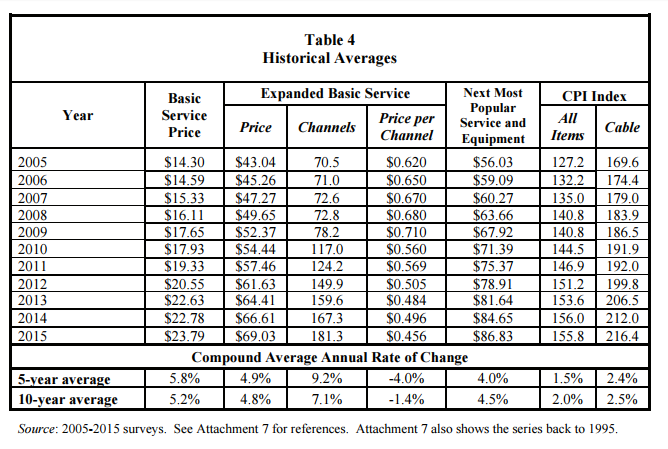
That is clear in the latest Federal Communications Commission report on content prices in the U.S. linear video market.
However, given diminished consumer appetite for the traditional �big content bundles� and a shift to over-the-top or on-demand viewing, it will be necessary for most, if not all, providers to �just say no� to content providers and restrict the size of bundles.
That is going to shift the way content gets to market, with increasing amounts of programming moving through new services such as Netflix and Amazon Prime.
According to a new FCC report, the average monthly price of expanded basic service (the combined price of basic service and the most subscribed cable programming tier excluding taxes, fees, and customer premises equipment charges) for the communities surveyed grew by 2.7 percent over the 12 months ending January 1, 2015, to $69.03, compared to a decrease of 0.1 percent in the consumer price index.
That is to say, linear video prices rose by an order of magnitude more than the overall level of consumer prices.
This compares to a compound ten-year average rate of increase from 2005 to 2015 of 4.8 percent in the price of expanded basic and a 1.5 percent increase in the CPI.
To be sure, linear video providers have argued in the past that prices are up in large part because the number of channels offered in bundles has grown.
The price per channel (price divided by number of channels) for subscribers purchasing expanded basic service decreased by 1.8 percent over the 12 months ending January 1, 2015, to 46 cents per channel.
Over the 10 years from 2005-2015, the price per channel has declined by 1.4 percent on an average annual compound basis.
In the past, consumers might not have had as much choice. In the future, they will. Prices are going to come down. Still, the issue is whether entertainment video might still outperform voice, texting or Internet access, in some cases, in terms of absolute revenue contribution, price per unit or profit margin.

source: FCC
download file now

Thursday, 14 September 2017
Theres a Reason You Dont Hear Specifics About Gigabit Take Rates
Theres a Reason You Dont Hear Specifics About Gigabit Take Rates
Back in the days when cable TV operators first were rolling out consumer Internet access at speeds of 100 Mbps, it was virtually impossible to get subscriber numbers from any of the providers, largely because http://liveeconcerts.blogspot.com /2010/06/how-much-speed-is-enough.html" style="text-decoration: none;">take rates were low.
In the United Kingdom, then planning on upgrading consumer Internet access speeds to �superfast� 30 Mbps, officials complained about http://liveeconcerts.blogspot.com /2011/11/ofcom-warns-of-low-interest-in-super.html" style="text-decoration: none;">low demand. In fact, demand for 40 Mbps was http://liveeconcerts.blogspot.com /2011/03/bt-uk-frustrated-by-lack-of-fttc-demand.html" style="text-decoration: none;">less than expected.
In 2010, for example, about 40 percent of U.S. consumers were buying Internet access at about http://liveeconcerts.blogspot.com /2013/02/100-mbps-access-will-be-common-by-2020.html" style="text-decoration: none;">6 Mbps.
It is possible the same remains true for gigabit access services. No Internet service provider of any size actually releases the number of accounts, though most are happy to cite cities and neighborhoods served, or homes able to buy the service (passings).
Those are significant indicators, but still do not address the question of how many customers actually buy.
Early in 2016, Paul de Sa, Bernstein Research equity analyst, predicted Google Fiber would reach roughly 2.4 million homes by the end of 2017.
MoffettNathanson at roughly the same time predicted that AT&T would reach 5 million "customer locations" by the end of 2017. CenturyLink estimated in late 2015 that it would have 700,000 households passed by gigabit access networks in operation by the end of 2015.
Comcast, for its part, plans to upgrade 100 percent of its consumer base to gigabit access over the next few years.
The issue will still remain the take rates.
CenturyLink executives, for example, have said that http://liveeconcerts.blogspot.com /2015/03/sometimes-gigabit-access-primarily.html" style="text-decoration: none;">gigabit marketing primarily drives new sales of accounts buying 20 Mbps or 40 Mbps service.
It is clear that price matters. When Internet service providers http://liveeconcerts.blogspot.com /2014/11/nextlight-municipal-gigabit-network.html" style="text-decoration: none;">drop the price enough to create a really-compelling value-price offer, consumers respond.
If ISPs do not readily announce the number of gigabit accounts they have in service, it likely is because relatively few consumers are buying those services.
Municipal gigabit access provider NextLIght expects a take rate of about 37 percent after five years, selling gigabit service at a charter rate of $50 a month ($100 a month is the standard rate).
Based on experience from other markets, NextLight will have the best chance to reach those adoption goals if it sells at the $50 price, not the the $100 price.
download file now
Subscribe to:
Posts (Atom)