Showing posts with label why. Show all posts
Showing posts with label why. Show all posts
Monday, 25 September 2017
The Reason Why Video Entertainment is The Only Service To Increase Prices
The Reason Why Video Entertainment is The Only Service To Increase Prices
Over the past several decades, it would have been a reasonable question to ask why entertainment video service prices grew faster than inflation, while retail prices for communications services (voice, texting, Internet access) declined, either on a price-per-unit basis or in terms of absolute price per unit.
The answer is simple: entertainment video is about the purchase of content, not access to content.
Compared to voice, texting or Internet access, entertainment video is more akin to fashion than a utility service. And that means retail price is not a direct function of production cost.
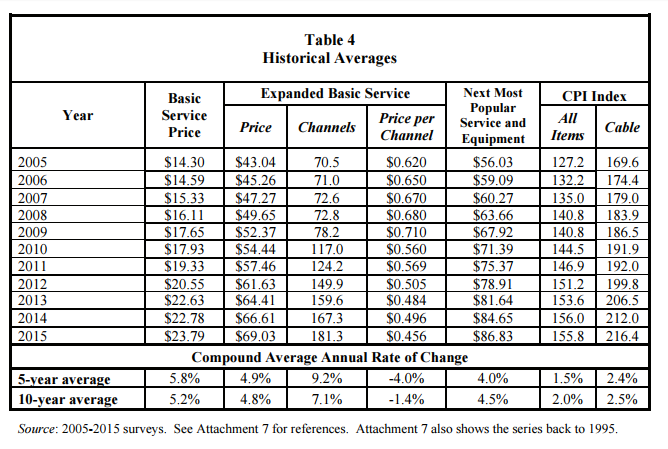
That is clear in the latest Federal Communications Commission report on content prices in the U.S. linear video market.
However, given diminished consumer appetite for the traditional �big content bundles� and a shift to over-the-top or on-demand viewing, it will be necessary for most, if not all, providers to �just say no� to content providers and restrict the size of bundles.
That is going to shift the way content gets to market, with increasing amounts of programming moving through new services such as Netflix and Amazon Prime.
According to a new FCC report, the average monthly price of expanded basic service (the combined price of basic service and the most subscribed cable programming tier excluding taxes, fees, and customer premises equipment charges) for the communities surveyed grew by 2.7 percent over the 12 months ending January 1, 2015, to $69.03, compared to a decrease of 0.1 percent in the consumer price index.
That is to say, linear video prices rose by an order of magnitude more than the overall level of consumer prices.
This compares to a compound ten-year average rate of increase from 2005 to 2015 of 4.8 percent in the price of expanded basic and a 1.5 percent increase in the CPI.
To be sure, linear video providers have argued in the past that prices are up in large part because the number of channels offered in bundles has grown.
The price per channel (price divided by number of channels) for subscribers purchasing expanded basic service decreased by 1.8 percent over the 12 months ending January 1, 2015, to 46 cents per channel.
Over the 10 years from 2005-2015, the price per channel has declined by 1.4 percent on an average annual compound basis.
In the past, consumers might not have had as much choice. In the future, they will. Prices are going to come down. Still, the issue is whether entertainment video might still outperform voice, texting or Internet access, in some cases, in terms of absolute revenue contribution, price per unit or profit margin.

source: FCC
download file now

Sunday, 17 September 2017
I KNOW WHY THE CAGED BIRD SINGS MAYA ANGELOU
I KNOW WHY THE CAGED BIRD SINGS MAYA ANGELOU
I Know Why the Caged Bird Sings is the 1969 autobiography about the early years of African-American writer and poet Maya Angelou. The first in a seven-volume series, it is a coming-of-age story that illustrates how strength of character and a love of literature can help overcome racism and trauma. The book begins when three-year-old Maya and her older brother are sent to Stamps, Arkansas, to live with their grandmother and ends when Maya becomes a mother at the age of 17. In the course of Caged Bird, Maya transforms from a victim of racism with an inferiority complex into a self-possessed, dignified young woman capable of responding to prejudice.
Angelou was challenged by her friend, author James Baldwin, and her editor, Robert Loomis, to write an autobiography that was also a piece of literature. Because Angelou uses thematic development and other techniques common to fiction, reviewers often categorize Caged Bird as autobiographical fiction, but the prevailing critical view characterizes it as an autobiography, a genre she attempts to critique, change, and expand. The book covers topics common to autobiographies written by Black American women in the years following the civil rights movement: a celebration of Black motherhood; a critique of racism; the importance of family; and the quest for independence, personal dignity, and self-definition.
Angelou uses her autobiography to explore subjects such as identity, rape, racism, and literacy. She also writes in new ways about womens lives in a male-dominated society. Maya, the younger version of Angelou and the books central character, has been called "a symbolic character for every black girl growing up in America". Angelous description of being raped as an eight-year-old child overwhelms the book, although it is presented briefly in the text. Rape is used as a metaphor for the suffering of her race. Another metaphor that of a bird struggling to escape its cage, is a central image throughout the work, which consists of "a sequence of lessons about resisting racist oppression". Angelous treatment of racism delivers a thematic unity to the book. Literacy, and seizing the power of words, helps young Maya cope with her bewildering world; books become her refuge as she works through her trauma.
Caged Bird was nominated for a National Book Award in 1970 and remained on The New York Times paperback bestseller list for two years. It has been used in educational settings from high schools to universities, and the book has been celebrated for creating new literary avenues for the American memoir. However, the books graphic depiction of childhood rape, racism, and sexuality has caused it to be challenged or banned in some schools and libraries.

Note: You are about to download a content that is appropriate only for adults and is not suitable for readers under the age of 18 years old.


download file now
Subscribe to:
Posts (Atom)